


Updated September 24, 2026
The dignity of risk is defined as the legal right of all people, including people with disabilities, to have the freedom of choice to make decisions and take chances in the world that can lead to growth, opportunity, and autonomy. It’s about self-determination.
Self Determination and the Dignity of Risk: Recovery Requires the Freedom to Fail
Every day, I watch people make decisions that scare the people who love them. Families often ask us to keep their loved ones safe from every possible setback. I understand the impulse. I also know that removing every risk removes something essential from recovery itself.
This tension has a name. It is called the dignity of risk, and the longer I do this work, the more important it becomes to me.

What Is the Dignity of Risk?
The dignity of risk is the right of every person to make informed choices and take reasonable risks in order to learn, grow, and build a better quality of life. It applies to all people, including people living with mental health diagnoses and disabilities.
At its core, the concept holds that self-determination and the right to take reasonable risks are essential to dignity and self-esteem. Excessively cautious caregiving, however well intended, can undermine both.
The idea traces back to Robert Perske, who challenged the overprotection of people with disabilities in his landmark 1972 work:
“Overprotection may appear on the surface to be kind, but it can be really evil. An oversupply can smother people emotionally, squeeze the life out of their hopes and expectations, and strip them of their dignity.”
Perske argued that overprotection keeps people from becoming all they can become.

A Debate Worth Having, Again and Again
The dignity of risk as a discussion is nothing new. The degree to which we “helpers” lean in one direction or another is worthy of continued debate. And we do: I spend a lot of time thinking about our role as a healing community in promoting outcomes that support our residents’ hopes and dreams. This gets into the art and craft of what we do, but in the end, the people we serve must stay at the center of the discussion.

The conversation becomes more complex, however, when you add families, friends, former treatment providers, and everyone else with a stake in a person’s future. Each one of them brings real love and real fear to the table.
I am deeply grateful that the good outcomes have significantly outweighed bad ones. The notably sad moments along the way, however, have had a profound effect on me.
After a bad outcome, I often reflect on whether we missed something or leaned too far in one direction. I wonder, too, whether those moments accumulate and imperceptibly make me more cautious—whether my belief in self-determination has slowly been eroded or tempered by hard experience, even as I continue to hold it.
That belief has not changed, but I reexamine it regularly and seriously. The arc of my conviction runs through every difficult outcome, not around it. Every outcome is factored into my position on the matter, and I stay in conversation with myself (and others) about it.
What Self-Determination Theory Tells Us About Recovery
It does seem intuitive to me that, generally speaking, the ability to direct one’s own life is a human right; and the more a person engages with their own desires and goals, the more involved and bought-in they become in their recovery. But my belief in self-determination rests on more than instinct. Decades of research back it up.
Self-Determination Theory identifies three psychological needs that underlie human growth:
- Autonomy: feeling you have choice and willingly endorse your own behavior.
- Competence: experiencing mastery and being effective in what you do.
- Relatedness: feeling connected and belonging with others.
When these three needs are supported, people thrive and achieve greater well-being. When they are thwarted, motivation withers.
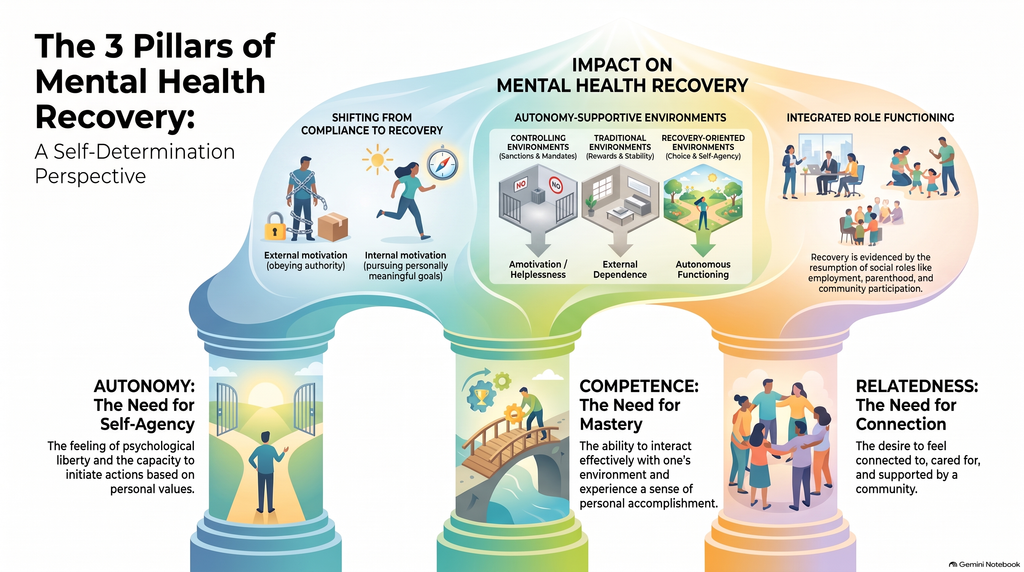
Researchers have recognized self-determination theory as a framework for the recovery paradigm in mental health services. One of the most important findings from this work is that the principal challenge of serious mental illness is often the loss of personal autonomy. That logically makes autonomy support central to effective treatment.
The evidence also demonstrates that greater self-determination is associated with better recovery outcomes, including engagement, social functioning, quality of life, and reduced impact of symptoms on daily life. Meeting the needs of autonomy, competence, and relatedness fortifies a person’s motivation to pursue and persist with their own goals.
There is also a hard truth in this research for those of us who help. Environments that support intrinsic motivation–the drive that comes from internal satisfaction–optimize effort, persistence, and performance. Coercive environments built on external pressure diminish all three. You cannot pressure someone into recovery. You can only build the conditions where they choose it.

If You Have Wished Your Loved One Would Take More Initiative
Here is where I want to speak directly to families. You may have wished your loved one would take more responsibility or initiative in their own life. You may have watched them stall in program after program and wondered why nothing sticks.
Self-determination theory offers an explanation: Initiative grows from autonomy and competence. A person who has had most decisions made for them has had few chances to practice either. On the other hand, experiencing consequences–including getting hurt, getting lost, or being heartbroken–helps all of us learn. It is natural to want to protect someone you love. It is also important not to take away their dignity of risk.
There is a related trap that many treatment systems fall into. Historically, an unrealistic expectation has existed that individuals must achieve perfection, or complete every single [provider-identified] treatment goal, before transitioning toward community living. That standard places unnecessary barriers in people’s paths and keeps them in institutional settings far longer than their needs require, leading paradoxically to worse outcomes.
Recovery takes practice, and practice requires real decisions with real stakes.

A Vision Worth the Risk
In 2003, DHHS published the final report of the President’s New Freedom Commission on Mental Health, titled Achieving the Promise: Transforming Mental Health Care in America. It said:
“We envision a future when everyone with a mental illness will recover…when everyone with a mental illness…has access to effective treatment and supports–essentials for living, working, learning, and participating fully in the community.”
For this to happen, the people being served must guide their own recovery experience. The systems of care that support them must be willing to risk success over the fear of failure. I see this happening at CooperRiis every day and continue to feel exhilarated by it.
Perske captured in 1981 why this self-guidance matters:
“Many of our best achievements came the hard way: We took risks, fell flat, suffered, picked ourselves up, and tried again. Sometimes we made it and sometimes we did not. Even so, we were given the chance to try. Persons living with disabilities need these chances, too.”
What Dignity of Risk Looks Like in Practice
At CooperRiis, we serve people with mental health conditions through a continuum of care. A typical progression begins at our program in Asheville (45 to 90 days), followed by a transition to The Farm at CooperRiis (3 to 6 months), and then into our community integration model, the Asheville Community Program, (6 to 12 months).
With each transition, the person makes challenging decisions. They make them with their full clinical team beside them. Notice how this maps onto the three needs that the research points to:
- Autonomy: Residents guide their own recovery, including whether and when to transition.
- Competence: Each stage builds skills and belief-in-self through real responsibility, such as our Community Work and Service crews.
- Relatedness: Every risk is considered and taken within a community that knows and supports them.

Many residents arrive here after other treatment programs where they made little meaningful progress. Here, the dignity of risk shows up in every recovery decision a person makes, large and small:
- Whether to get up in the morning
- Choosing to join a work crew.
- Taking on the longstanding issues that have prevented happiness or stability.
These risky daily decisions accompany the big, overriding question of what to do next.
Where This Leaves Us
The dignity of risk asks something hard of families, clinicians, and professionals like me. It asks us to hold our fear while someone we care about takes a chance that matters to them. The research on self-determination, plus the years of watching residents grow, gives me confidence that this is the right kind of hard.

If you want to go deeper, the Temple University Collaborative has a thoughtful paper on managing risk in community inclusion and promoting the dignity of risk.
Thank you for reading,
Eric A. Levine, Ed.D
President & CEO